money
How to Calculate Your Net Salary in Switzerland: Complete Guide 2026
Between the gross salary on your contract and what lands in your bank account every month, several mandatory deductions apply. Complete guide with 2026 rates, practical examples, and the HelviNav salary calculator to get the numbers right.
André ·
You moved to Switzerland or you are thinking about it. You got a job offer with a gross salary of 80,000 CHF per year. Sounds like a lot, but after all deductions, how much actually lands in your account each month? The answer is not straightforward — it depends on your canton, age, marital status, and even your religion.
This guide walks you through every deduction on your payslip, how much each one costs, and how to calculate your net salary with a practical example. At the end, you will find the HelviNav salary calculator to run the numbers for your own situation.
What Is Gross Salary and Net Salary?
Net salary on a payslip is gross salary minus payroll deductions. Withholding tax may be deducted on the payslip; ordinary income tax and health-insurance bills can be payable separately.
In Switzerland, deductions fall into three main groups:
Social security (AHV/IV/EO) — the first pillar, mandatory for everyone
Pension fund (BVG) — the second pillar, mandatory above a certain salary
Taxes — source tax for foreigners, or cantonal taxes for Swiss and C permit holders
On top of that, there is unemployment insurance (ALV), accident insurance (UVG/LAA), and possibly daily sickness benefit insurance (KTG) if your company has a collective plan.
AHV/IV/EO — The First Pillar (Social Security)
AHV (old-age and survivors insurance), IV (disability insurance) and EO (loss of earnings insurance) form the foundation of Swiss social security. They are mandatory for all employees, including foreigners with a B or L permit.
AHV (Old-age/Survivors): 4.35% employee + 4.35% employer
IV (Disability): 0.70% employee + 0.70% employer
EO (Loss of earnings): 0.25% employee + 0.25% employer
Total AHV/IV/EO: 5.30% employee + 5.30% employer = 10.60%
AHV/IV/EO contributions apply to the full contributory salary without an upper salary cap. The CHF 88,200 figure was a former occupational-pension limit, not an AHV cap abolished in 2024. Special rules can apply after reference age.
Official source: ahv-iv.ch — Beitragssätze | bsv.admin.ch
ALV — Unemployment Insurance
Unemployment insurance (Arbeitslosenversicherung / Assurance-chômage) covers you if you lose your job. The rate is the same for everyone:
Up to CHF 148,200/year: 1.10% employee + 1.10% employer = 2.20%
Above CHF 148,200/year: no ALV contribution on the excess. The solidarity contribution ended on 1 January 2023.
In 2026, the employee ALV rate is 1.10% up to an annual salary of CHF 148,200; the employer pays the same amount.
Official source: seco.admin.ch — ALV
BVG — The Second Pillar (Pension Fund)
BVG (Berufliche Vorsorge / Prévoyance professionnelle) is mandatory retirement savings. It works like an account managed by a foundation or insurance company, where you and your employer deposit a percentage of your salary every month.
In the compulsory BVG minimum plan for 2026, the coordination deduction is CHF 26,460, the entry threshold CHF 22,680 and the upper salary limit CHF 90,720. The coordinated salary is bounded between CHF 3,780 and CHF 64,260. A pension plan can provide broader coverage.
Coordination deduction (2026 statutory minimum): CHF 26,460
These are minimum retirement savings credits by age, not the whole pension premium. Risk and administration charges can add to the deduction. The employer must fund at least half of the total contributions for its employees; the split shown below assumes equal shares.
Ages 25–34: 7% total (3.50% employee + 3.50% employer)
Ages 35–44: 10% total (5.00% employee + 5.00% employer)
Ages 45–54: 15% total (7.50% employee + 7.50% employer)
From age 55 to reference age: 18% savings credit (9% each if split equally). The reference age for women rises gradually to 65; check the applicable birth-year rules.
Example, age 35 and CHF 80,000/year: 80,000 − 26,460 = CHF 53,540 coordinated salary. A 10% savings credit is CHF 5,354/year; an assumed equal employee share is CHF 2,677/year, excluding risk and administration charges.
Important note: Many companies have BVG plans above the legal minimum — higher rates, lower coordination deductions, or more generous employer contributions. Your employment contract or pension fund regulations will tell you exactly what applies.
Official source: bsv.admin.ch — BVG
Accident Insurance (UVG/LAA)
Accident insurance is mandatory for all employees in Switzerland. It has two parts:
Occupational accidents: the employer pays the premium.
Non-occupational accidents: employees working at least eight hours per week for one employer are covered; premiums may be charged to the employee.
Below eight hours per week with the same employer, commuting accidents are covered as occupational accidents, but leisure accidents need separate cover. Non-occupational premiums vary by insurer and risk; there is no universal payroll rate.
Official source: Suva | bsv.admin.ch — UVG
Sickness Daily Benefit Insurance (KTG)
Daily sickness benefit insurance is not generally compulsory under federal law. Your employment or collective agreement can require a policy. Coverage, waiting periods and any employee premium depend on that policy; check your contract and payslip.
Source Tax (Quellensteuer)
Foreign residents without a C permit are generally subject to withholding tax on employment income. Exceptions include living with a Swiss spouse or a spouse holding a C permit. Cross-border cases have separate rules; confirm your situation with the canton.
The source tax rate depends on several factors:
Gross salary — the more you earn, the more you pay
Canton of residence — each canton has its own tax table
Marital status — single, married, divorced
Children — deductions per child
Religion — in Switzerland, the church also collects tax
Withholding tax includes federal, cantonal and municipal income tax. A subsequent ordinary assessment can still be required, including for Swiss residents with gross employment income of at least CHF 120,000/year, or other income or assets under cantonal rules.
Tip: You can simulate your source tax on your canton website. Some cantons offer free online simulators.
Official source: estv.admin.ch — Quellensteuer
Step-by-Step Practical Example
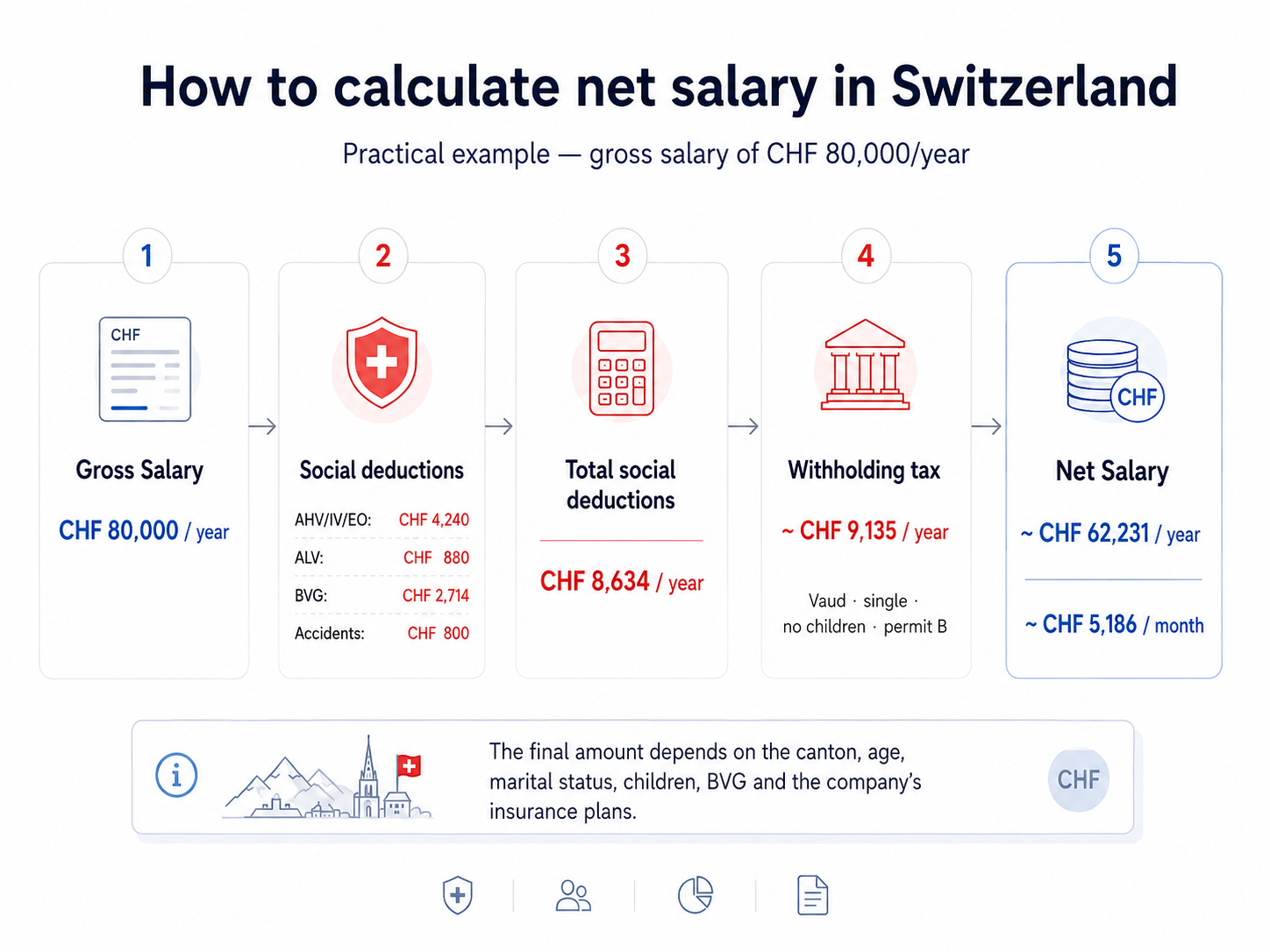
This simplified example calculates the amount remaining BEFORE withholding tax. It assumes equal pension savings shares, no pension risk/administration premium and an illustrative 1% non-occupational accident premium; your actual plan can differ.
Gross annual salary: CHF 80,000
Age: 35
Permit: B (source tax)
Canton: Vaud
Marital status: Single, no children
Religion: None (no church tax)
BVG: Legal minimum
Accident insurance (non-occupational): 1.0%
Step 1: AHV/IV/EO
80,000 CHF × 5.30% = 4,240 CHF/year (353 CHF/month)
Step 2: ALV (Unemployment)
80,000 CHF is below the 148,200 CHF threshold, so: 80,000 × 1.10% = 880 CHF/year (73 CHF/month)
Step 3: BVG (2nd Pillar)
Coordinated salary: 80,000 − 26,460 = CHF 53,540. Savings credit at age 35: 10%, or CHF 5,354/year. Assumed employee half: CHF 2,677/year (CHF 223.08/month over 12 payments), before pension risk/administration charges.
Step 4: Accident Insurance (non-occupational)
80,000 × 1.0% = 800 CHF/year (67 CHF/month)
Step 5: Total Social Deductions
AHV/IV/EO: 4,240 CHF/year (353 CHF/month)
ALV: 880 CHF/year (73 CHF/month)
BVG savings share: CHF 2,677/year (CHF 223.08/month over 12 payments)
Accident: 800 CHF/year (67 CHF/month)
Total illustrated deductions: CHF 8,597/year (CHF 716.42/month over 12 payments).
Step 6: Source Tax
Use the applicable official canton tariff and gross taxable salary to determine withholding tax. No verified Vaud tariff rate is assumed in this example.
Do not apply a guessed percentage to salary after social deductions. Withholding tax calculation depends on the canton’s taxable pay and tariff rules.
Illustrated subtotal, before withholding tax:
Gross annual salary: 80,000 CHF
Illustrated social deductions: − CHF 8,597
Withholding tax: not calculated in this example
Annual amount before withholding tax: CHF 71,403
Monthly amount before withholding tax: CHF 5,950.25 over 12 payments
This is not a take-home salary quote. Subtract the applicable withholding tax and any additional contractual premiums. Ordinary income tax and health insurance may be paid separately.
Use the HelviNav Salary Calculator
Use the HelviNav calculator for a planning estimate. Read the displayed coverage and assumptions, then compare with your pension statement, payslip and official canton tariff.
Canton selection with coverage/status shown
Simplified pension assumptions shown in the result; not your personal pension plan
Source tax by canton and marital status
Explore different canton scenarios
Frequently Asked Questions
Is accident cover always deducted? Occupational accident premiums are paid by the employer. Non-occupational coverage depends on weekly hours; any employee premium depends on the policy.
What happens if I move to a different canton? Your source tax changes because each canton has its own tax rates. Your employer updates the rate automatically when you change your residence.
Do I need a tax return with withholding tax? A subsequent ordinary assessment can be compulsory or requested. For Swiss residents, CHF 120,000 gross employment income is one trigger; other income/assets and cantonal rules also matter. Check the canton’s eligibility rules and deadlines.
Is BVG portable? On a job change, vested benefits transfer to the new pension institution. Cash withdrawal when leaving Switzerland has conditions; the compulsory portion generally cannot be withdrawn when moving to an EU/EFTA country where you remain compulsorily insured. Check your pension institution before deciding.
What is the 13th salary? Many Swiss contracts include a 13th salary. It equals one month of gross salary and is subject to the same social deductions.
Official Sources
AHV/IV — Informationsstelle AHV/IV
BSV — Federal Social Insurance Office
SECO — State Secretariat for Economic Affairs
ESTV — Federal Tax Administration
Sources checked on 13 October 2026. The example uses 2026 statutory pension figures and explicit illustrative assumptions; it is not a personal payroll or tax quote. Your pension rules, contract and official canton tariff determine the actual deductions.