home
Rent Reduction in Switzerland: Complete Guide (2026)
If the mortgage reference rate drops, you may be entitled to a rent reduction. Complete guide with the step-by-step process, official templates, deadlines, and the HelviNav calculator.
André ·

What Is the Mortgage Reference Rate?
The mortgage reference rate (hypothekarischer Referenzzinssatz) is the average interest rate on mortgage loans in Switzerland. It is calculated and published by the Federal Housing Office (BWO/OFL), not by the SNB. The SNB influences the interest rate market, but the reference rate for rents is the responsibility of the BWO. It is published quarterly: on March 1, June 1, September 1, and December 1.
This rate matters for tenants because it serves as the legal basis for rent calculations. When the reference rate drops, the tenant can request a rent reduction. The landlord must review the request but may contest or partially offset it with inflation, cost increases, renovations, or other legal factors.
The rate was at 3.5% in 2008 and gradually declined to 1.25% by September 2020. In 2023/2024, as interest rates rose, the reference rate increased temporarily. It later decreased again. At the time of this update, the mortgage reference rate is 1.25%. Always check the current rate on the BWO website before making your request.
When Can You Request a Rent Reduction?
You are entitled to request a rent reduction whenever the mortgage reference rate drops by 0.25 percentage points (or more) compared to the rate in effect when your rent was set or last adjusted.
The drop must be at least 0.25 percentage points
The request can be made as soon as the new rate takes effect
The tenant can submit a written request; the landlord must review it and respond within the legal timeframe
If you do not ask, the landlord is not obliged to reduce the rent
The reduction is not retroactive. It only counts from the formal request, normally applying from the next possible contractual term in accordance with legal deadlines. So the sooner you ask, the more you save.
How Much Can You Reduce the Rent?
The rent reduction is calculated based on the average mortgage financing percentage of the building. The reference value used by Swiss courts is 35% to 40% of the net rent: that is, the rent without service charges. Charges (heating, water, etc.) are not included in the base calculation for the reduction.
Rule of thumb (used as a reference by the courts):
For every 0.25 percentage point drop in the reference rate, the net rent can be reduced by approximately 2.91% (reference value, subject to legal offsets).
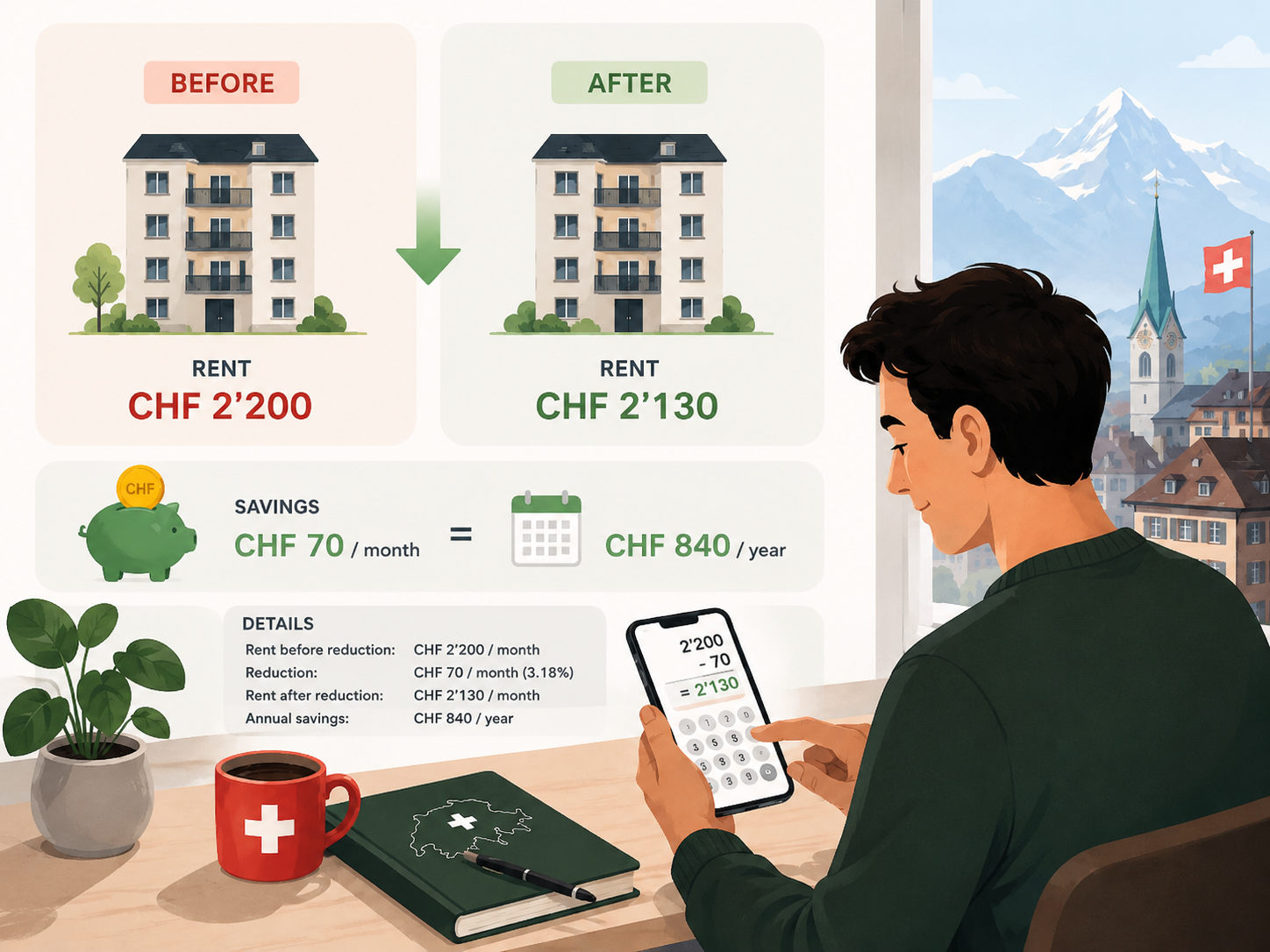
On a rent of CHF 2,000/month, a 0.25 percentage point drop could mean a reduction of CHF 56 to CHF 60 per month.
The exact amount depends on your specific situation: best to use the HelviNav calculator with your data.
Step by Step: How to Request the Reduction
Step 1: Check the current reference rate — Check the current rate on the BWO website (bwo.admin.ch). Compare it with the rate that was in effect when you signed the contract or when the rent was last adjusted.
Step 2: Calculate the reduction you are entitled to — Use the HelviNav rent reduction calculator to find out exactly how much you can save. Just enter your current rent and the reference rate from your contract: the calculator does the rest.
Step 3: Prepare the formal request — The request must be made in writing (registered letter or email with read receipt) and should include: your details (name, address, tenant number if applicable), the current reference rate and the date it took effect, the previous reference rate (from your contract or last adjustment), the amount of reduction you are requesting, and reference to the drop in the reference rate and the tenant's right to request a reduction.
Step 4: Send and wait for a response — The landlord should respond within a reasonable time. If they agree, the reduction applies from the next possible contractual term, respecting the contract and legal deadlines. If they refuse or do not respond, the tenant can appeal to the cantonal conciliation authority (Schlichtungsbehörde / autorité de conciliation) within 30 days (Art. 270a OR).
Step 5: If the landlord refuses — If refused, contact your cantonal conciliation authority within the applicable deadline (generally 30 days after the refusal). The process is free or low-cost in most cantons, and you do not need a lawyer for the first stage.
Practical Example
Maria lives in Lausanne and pays CHF 2,200/month in net rent (without charges). The contract was signed in 2020, when the reference rate was 1.25%.
At the time of this update, the reference rate is also 1.25%. In this case, Maria would not be entitled to a reduction because the rate has not dropped since the contract was signed.
But let us imagine the rate drops by 0.25 percentage points (to 1.00%).
Approximate reduction: 2.91% of CHF 2,200 ≈ CHF 64/month New approximate net rent: CHF 2,136/month Approximate annual savings: about CHF 768/year
Use the HelviNav rent reduction calculator to calculate your own situation.
Frequently Asked Questions
Can the landlord increase the rent when the reference rate goes up? Yes, if the rate rises by 0.25 percentage points or more, the landlord can increase the rent proportionally. However, they must do so formally, using the official form, and respecting legal deadlines.
Is the rent reduction automatic? No. The landlord is not obliged to reduce the rent without a request from the tenant. You have to ask.
Can I request a reduction if I moved recently? It depends. If the rent was set based on a different reference rate (the one at the time of signing), you can request it if that rate has dropped since then.
Do I need a lawyer to request the reduction? No. The request is simple and you can do it yourself. If the landlord refuses, the conciliation authority does not require a lawyer.
What happens if the building is sold? The new owner inherits the conditions of the lease agreement, including the applicable reference rate.
Does the reduction apply to gross or net rent? It applies to the net rent (excluding service charges). Charges such as heating, water, or other ancillary costs are not included in the base calculation for the reduction. The final amount may be lower if there are legal offsets by the landlord.
Official Sources
BWO/OFL: Current and historical mortgage reference rate Swiss Tenants Association HelviNav: Rent Reduction Calculator
The rates and values presented in this guide are based on Swiss legislation in force in 2026. Each case may vary depending on the canton, the lease agreement, and specific conditions. The rules may differ if the contract has special clauses. I recommend checking the current reference rate on the BWO/OFL website and, if necessary, consulting a tenants association before making the request.